

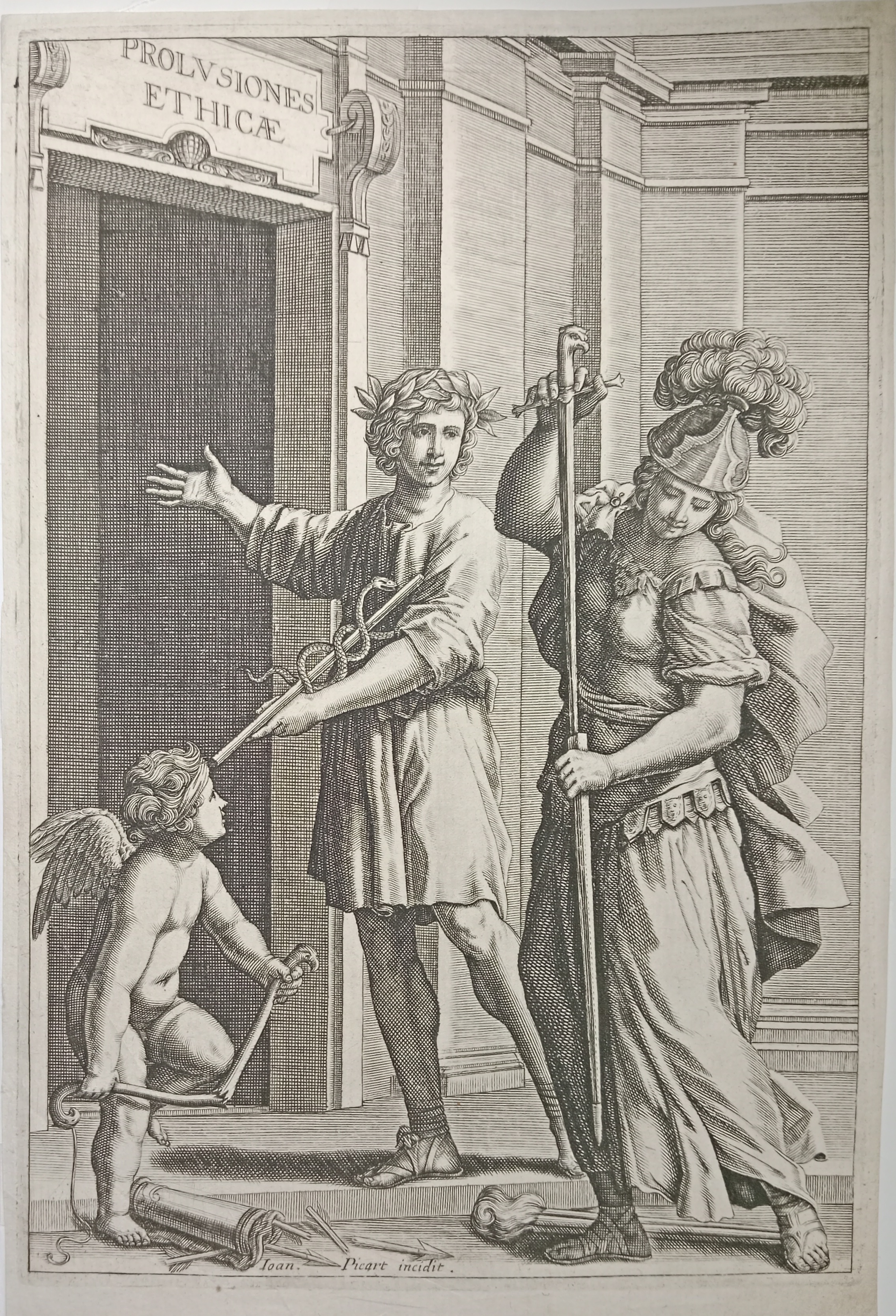
MERCURIO MUESTRA LA ENTRADA A ATENEA Y CUPIDO
ICONOGRAFÍA / ICONOGRAPHY
Mercurio/Sabiduría (Centro):
Viste una corona de laurel y una túnica, sosteniendo el caduceo en su mano derecha. Toca la cabeza de Cupido con el caduceo, señalando la entrada al estudio ético.
Minerva/Atenea (Derecha):
Figura con casco con cresta, escudo/armadura y lanza/espada, que representa la Virtud y la Sabiduría, alejando o guiando las pasiones terrenales.
Cupido/Amor (Abajo a la izquierda):
Representado rompiendo su arco, con su carcaj y flechas tiradas en el suelo a sus pies, simbolizando el triunfo de la razón ética y la virtud sobre la pasión ciega o el amor terrenal.
Mercury / Wisdom (Center):
Wears a laurel wreath and tunic, holding the caduceus in his right hand. He touches the head of Cupid with the caduceus, gesturing toward the entrance of ethical study.
Minerva / Athena (Right):
Helmeted figure with a crested helmet, shield/armor details, and spear/sword, representing Virtue and Wisdom warding off or guiding earthly passions.
Cupid / Amor (Bottom Left):
Depicted breaking his bow, with his quiver and arrows discarded on the ground at his feet, symbolizing the triumph of ethical reason and virtue over blind passion or earthly love.
TITULO / TITLE :
Mercurio muestra la entrada a Atenea y Cupido
EDITOR / PUBLISHED:
Sébastien Cramoisy, París.
AUTOR / AUTHOR :
Jacques Stella ( 1596–1657 ).
Aunque el dibujo original se considera perdido, la composición e invención estilística corresponden a este destacado pintor del clasicismo francés.
Although the original drawing is considered lost, the composition and stylistic invention correspond to this prominent painter of French classicism.
GRABADOR / ENGRAVER :
Jean Picart ( ? - 1670 )
DATOS BIOGRAFICOS / BIOGRAPHICAL DATA :
MEDIDAS / MEASURES :
21 x 14 cm
FECHA DE ESTAMPACIÓN / STAMPING DATE:
1636 a 1639, S / XVII
TECNICA / TECHNIQUE :
Grabado a buril / Burin engraving
MATERIAL / MATERIAL :
Papier Vergé du 17e siècle
ESCUELA / SCHOOL :
Escuela Francesa / French School
SUJETO / SUBJECT:
Mitología Clásica / Classical Mythology
SERIES / SERIES :
Grabado del Siglo XVII / 17th century engraving
Mitología clásica / Classical Mythology
OBSERVACIONES / OBSERVATIONS :
Grabado frontispicio prominente de la publicación :
Engraved of the publication :

Avgvstini Mascardi, Ethicae Prolusiones, Parisiis apud Sebastianum Cramoisy , Typographum Regis Ordinarium ... M.DC.XXXIX Cvm Privilegios Regis.

En 1636 el Cardenal Príncipe Mauricio de Saboya ( 1593 - 1657 ) encargo al humanista y escritor Agostino Mascardi ( 1591 - 1640 ) por aquel entonces profesor de retorica en la Universidad de Génova unos textos sobre temas éticos, en 1639 fueron publicados en París por el librero e impresor Sebastián Cramoisy ( 1585 - 1669 ) director de la imprenta real instaurada por Luis XIII de Francia, publicación adornada con un bello frontispicio realizado por el grabador Jean Picart ( ? - 1670 ) Ethicae Prolusiones fue la última obra publicada y escrita por Agostino Mascardi, aquejado de unas dolencias se retiro a finales de 1639 a Sarzana su ciudad natal donde fallecería a comienzos de 1640.
REFERENCIAS / REFERENCES :
* Biblioteca Nacional de España, sig 3/46784
* Bibliothèque National de France, cat. bnf.fr/ark:12148/cb309007972
CATALOGO / CATALOGUE
Carpeta del Siglo XVII, C 2 / 17th entury folder ,C 2

