ESCENA. Grabado del Siglo XIX

ESCENA
 

ESCENA

Este grabado es una lámina que ilustra el Libro VII (Livre VII) de la Eneida de Virgilio, de la célebre traducción francesa en verso del abad Jacques Delille (1738-1813), publicada en París por Giguet y Michaud en 1804 (Año XII).

This engraving is a plate illustrating Book VII (Livre VII) of Virgil's L'Énéide, from the celebrated French translation in verse by the Abbé Jacques Delille (1738–1813), published in Paris by Giguet and Michaud in 1804 (An XII).

ICONOGRAFÍA / ICONOGRAPHY
La escena retrata un tenso enfrentamiento político y doméstico en el palacio de Laurentum. A la derecha, el rey Latino está sentado ante una mesa trípode de estilo clásico, con expresión grave y a la defensiva. A la izquierda, la reina Amata —ya sutilmente manipulada por la furia de Alecto— se aferra desesperadamente a su joven hija Lavinia, tirando de ella hacia atrás mientras dirige una mirada acusadora y cargada de emoción a Latino.

The scene captures a high-stakes domestic and political confrontation within the palace of Laurentum. On the right, King Latinus sits at a classicized tripod table, his expression grave and defensive. On the left, Queen Amata—already being subtly manipulated by the fury Alecto—clings despairingly to her young daughter Lavinia, pulling her backward while casting an accusing, emotional gaze at Latinus.

TITULO / TITLE :
Escena

AUTOR / AUTHOR:
Jean-Michel Moreau le Jeune (1741–1814), uno de los ilustradores y dibujantes franceses más prolíficos y estimados de finales del siglo XVIII y principios del XIX.

Jean-Michel Moreau le Jeune (1741–1814), one of the most prolific and esteemed French illustrators and draftspersons of the late 18th and early 19th centuries.

GRABADOR / ENGRAVED :
Jean - Louis  Delignon ( 1755 - 1820 )

DATOS BIOGRÁFICOS / BIOGRAPHICAL DATA :

MEDIDAS / MEASURES :
9 x 14cm

TÉCNICA / TECHNIQUE :
Grabado a buril / Burin engraving

ESCUELA / SCHOOL :
Escuela Francesa / French School

FECHA DE ESTAMPACIÓN / STAMPING DATA :
1810, S / XIX

SERIES / SERIES:
Grabado del Siglo XIX / 19th century engraving

CATÁLOGO / CATALOGUE :
Carpeta del Siglo XIX, C 1 A - Subcarpeta 9
19th century folder C 1 A - Subfolder 9

GUSTAVUS LORD VISCOUNT BOYNE. 19rh century engraving

 GUSTAVUS LORD VISCOUNT  BOYNE


Esta lámina es un grabado de cuerpo entero que representa a Gustavus Hamilton, segundo vizconde de Boyne (1710-1746), un noble y político irlandés conocido por sus viajes por Europa (en particular a Venecia) y por su nombramiento como comisionado de Hacienda para Irlanda.

This print is a full-length portrait engraving of Gustavus Hamilton, 2nd Viscount Boyne (1710–1746), an Irish peer and politician known for his grand tour travels (particularly to Venice) and his appointment as a commissioner for Irish Revenue.

TITULO / TITLE :
Gustavus Lord Viscount Boyne

EDITOR / PUBLISHER :

GRABADOR / ENGRAVED :
Thomas Cook ( 1744 - 1818 )

DATOS BIOGRÁFICOS / BIOGRAPHICAL DATA:

MEDIDAS / MEASURES :
20 x 26.5 cm

TÉCNICA / TECHNIQUE :

FECHA DE ESTAMPACIÓN / STAMPING DATA :
1808, S / XIX

SERIES / SERIES :
Grabado del Siglo XIX / 19th century engraving

OBSERVACIONES / OBSERVATIONS :

Grabado prominente de la publicación :
Prominent engraving of the publication :


CATÁLOGO / CATALOGUE :
Carpeta del Siglo XIX A C 1 - Subcarpeta 9
19th century folder A C 1 - Subfolder 9

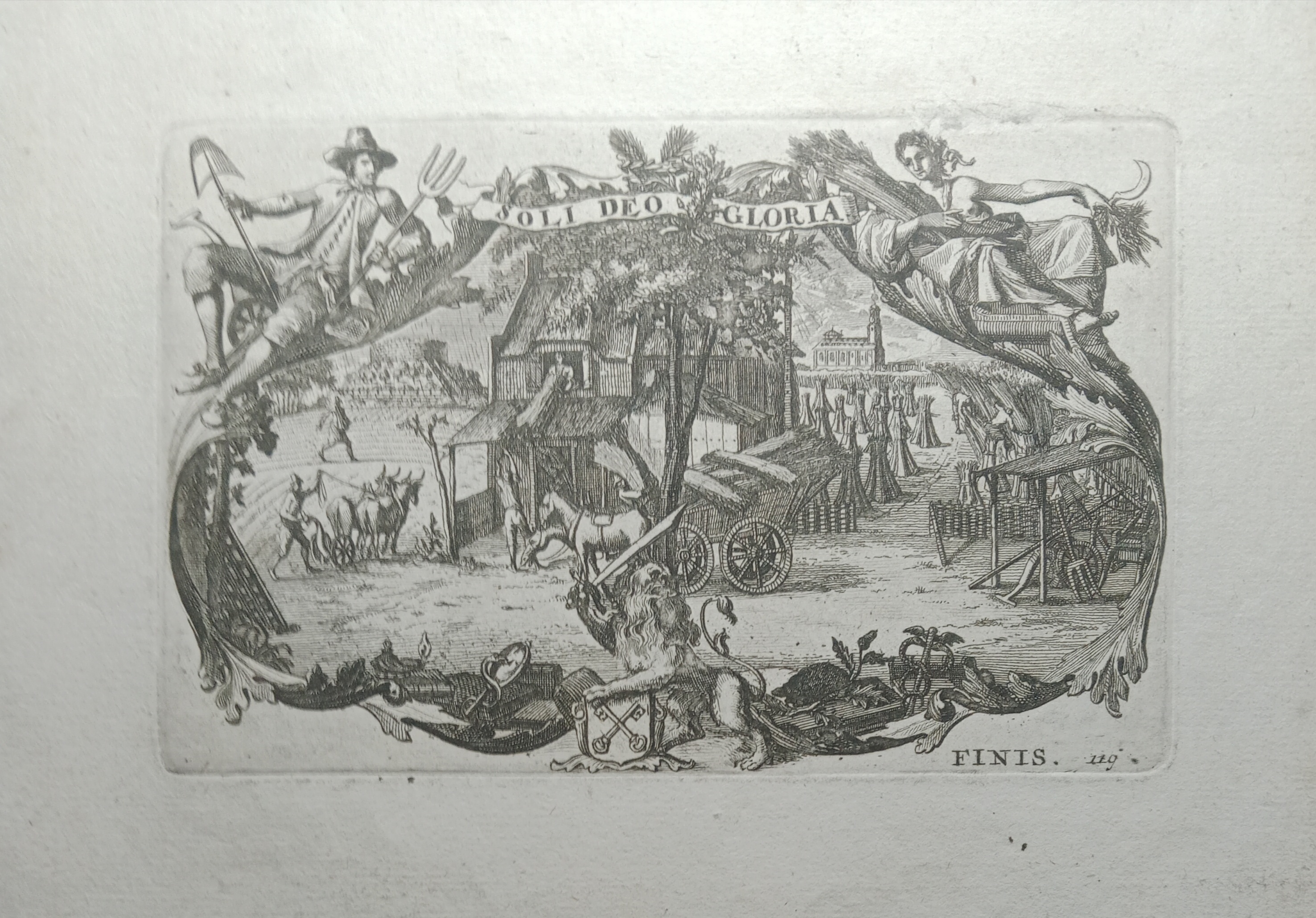
SOLI DEO GLORIA. 18th century engraving

Grabado del Siglo XVIII
 

SOLI DEO GLORIA

Esta calcografía es muy probablemente un remate, cul-de-lampe o grabado final de un libro— cargada de una rica iconografía alegórica típica del período comprendido entre los siglos XVI y XVIII.


La presencia de la palabra "FINIS." en la esquina inferior derecha, junto con la numeración de página 119, confirma que se trata de la ilustración que cerraba un capítulo o el final de una obra impresa.


La inscripción en la filacteria superior, "SOLI DEO GLORIA" (Solo a Dios la gloria), era una de las cinco solas de la Reforma, pero también un lema ampliamente utilizado por impresores, autores y artistas de diversas confesiones de la época barroca para dar gracias al concluir un trabajo arduo.


El diseño presenta una estructura simétrica enmarcada por una densa rocalla y motivos vegetales que encierran una detallada escena rural y de oficios varios.

_________________________


This intaglio print is most likely a colophon, cul-de-lampe or final engraving from a bookrich in the allegorical iconography typical of the period spanning the 16th to the 18th centuries.

The presence of the wordFINIS.’ in the bottom right-hand corner, together with the page number 119, confirms that this is the illustration that concluded a chapter or marked the end of a printed work.

The inscription in the upper scroll, “SOLI DEO GLORIA” (Glory to God alone), was one of the five solas of the Reformation, but also a motto widely used by printers, authors and artists of various denominations during the Baroque period to give thanks upon completing a labourious task.

The design features a symmetrical structure framed by dense rocaille and plant motifs that enclose a detailed rural scene depicting various trades.

TITULO / TITLE :

GRABADOR / ENGRAVER :

MEDIDAS / MEASURES :

FECHA DE ESTAMPACIÓN / STAMPING DATA :

SERIES / SERIES :

Grabado del Siglo XVIII / 18th century engraving
Portadas / Cover pages

CATÁLOGO / CATALOGUE :

ESCENA DE GENERO. Grabado del Siglo XVIII


ESCENA DE GENERO

Se trata de una ilustración de libro del siglo XVIII (probablemente un grabado o aguafuerte sobre cobre, en formato octavo o duodécimo) diseñada para acompañar una obra de ficción, un poema satírico o una comedia teatral. La inscripción «Página 38» en la parte superior indica su ubicación dentro del volumen en el que estaba encuadernada.

This is an 18th-century book illustration (likely an engraving or etching on copper, format octavo or duodecimo) designed to accompany a work of fiction, a satirical poem, or a theatrical comedy. The inscription "Page 38." at the top indicates its placement within the volume it was bound into.
TITULO / TITLE :

GRABADOR / ENGRAVER :
Desconocido / Unknown

MEDIDAS / MEASURES :
9 x 14 cm

TECNICA / TECHNIQUE :
Grabado a buril / Burin engraving

ESCUELA / SCHOOL :
Escuela Francesa / French School

FECHA DE ESTAMPACIÓN / STAMPING DATA :
1780ca, S / XIX

CATÁLOGO / CATALOGUE :
Carpeta del Siglo XIX, C 2 - Subcarpeta 7
19th century folder C 2 - Subfolder 7