

SCÈNE GALANTE
18th century engraving
18th century engraving
SCÈNE GALANTE
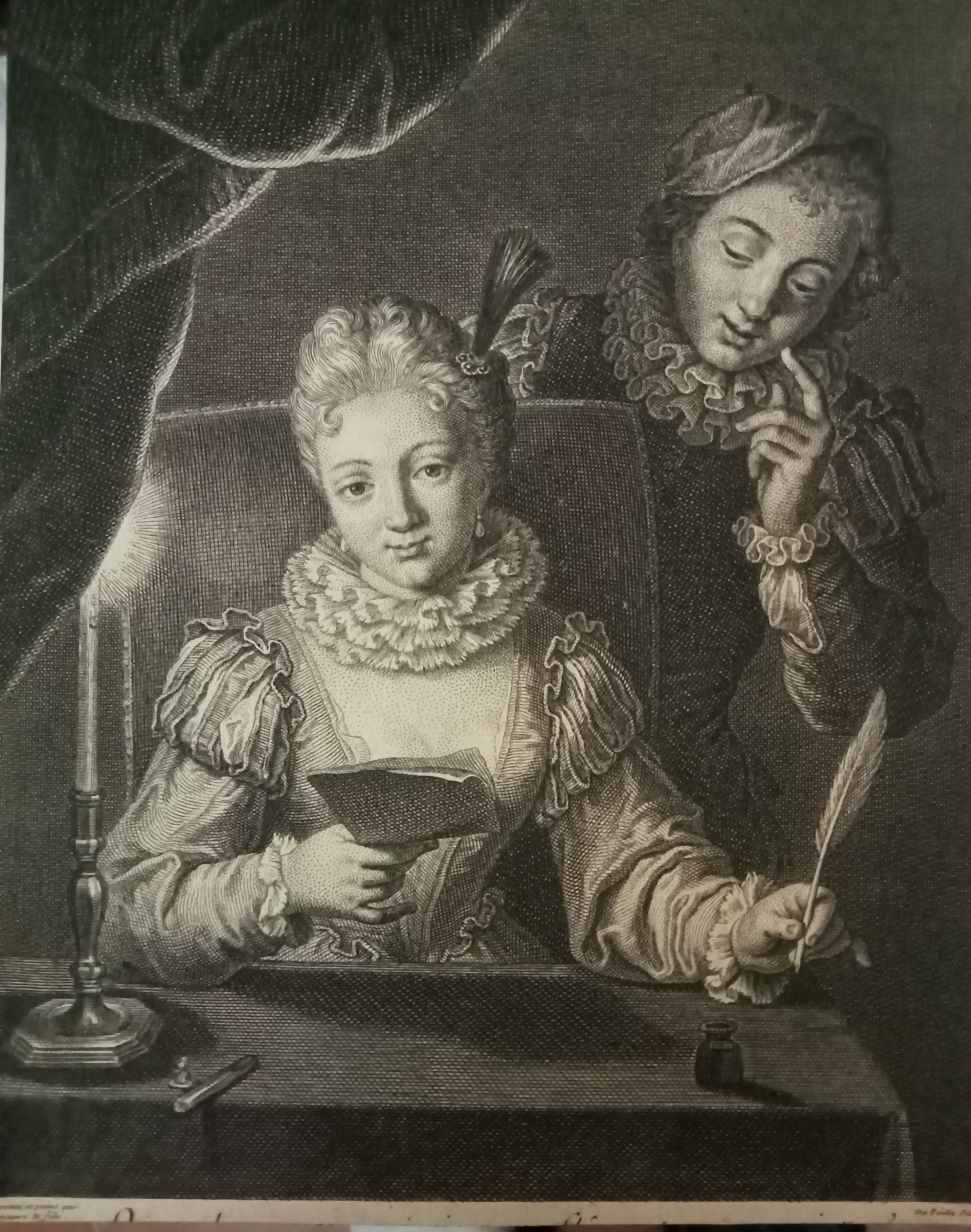
Scène Galante es un grabado representando una escena del renacimiento, una joven en un escritorio con un tintero a la luz de una vela, en una mano una carta y en la otra una pluma, observado por un joven en segundo plano.
Scène Galante is an engraving representing a Renaissance scene, a young woman at a desk with an inkwell in the light of a candle, in one hand a letter and in the other a pen, observed by a young man in the background.
ICONOGRAFÍA / ICONOGRAPHY
La Figura Interrumpida/Guía:
El joven que se inclina sobre su hombro sosteniendo una pluma introduce una doble interpretación: actúa como mentor/escriba que guía su mano, como cómplice que comparte un secreto o como un admirador romántico que le ofrece una carta de amor.
Claroscuro y Luz de Vela:
La vela encendida sirve como fuente de luz principal, creando un fuerte contraste (claroscuro). Más allá de su iluminación práctica, la luz de la vela simboliza tradicionalmente la intimidad, el estudio nocturno, el romance oculto o la naturaleza transitoria del tiempo (vanitas).
Indumentaria historicizada (estilo trovadoresco/anacrónico):
Ambas figuras lucen prominentes gorgueras de molino (cuellos de fraise), mangas abullonadas con aberturas y adornos capilares típicos de la moda del norte de Europa de finales del siglo XVI. En el grabado de los siglos XVIII y XIX, esta estética suele reflejar una escena de género histórica (estilo trovadoresco), romantizando la vida cortesana renacentista y los amoríos secretos.
Encuadre con cortinas:
La pesada cortina recogida a la izquierda actúa como recurso teatral, invitando al espectador a observar un momento íntimo y vulnerable
_____________________________________________________
The Secret Letter (Epistolary Motif):
The central narrative revolves around the writing or receiving of a confidential message. The seated woman holds a folded paper or letter, while an inkwell, quill, and sealing wax/stamp sit on the desk, symbolizing romance, intrigue, or clandestine communication.
The Interrupted / Guiding Figure:
The young man leaning over her shoulder holding a quill introduces a dual reading—he acts either as a mentor/scribe guiding her hand, an accomplice sharing a secret, or a romantic admirer offering a love letter.
Chiaroscuro & Candlelight:
The single burning candle serves as the primary light source, creating strong contrast (chiaroscuro). Beyond its practical illumination, the candlelight traditionally symbolizes intimacy, late-night study, hidden romance, or the transient nature of time (vanitas).
Historicized Attire (Troubadour / Anachronistic Style):
Both figures wear prominent millstone ruffs (fraise collars), slashed puffed sleeves, and hair ornamentation typical of late 16th-century Northern European fashion. In 18th- or 19th-century printmaking, this aesthetic often reflects a historical genre scene (Troubadour style), romanticizing Renaissance court life and secret amorous affairs.
Drapery Framing:
The heavy curtain pulled back on the left acts as a theatrical device, inviting the viewer to look in on a private, vulnerable moment.
TITULO / TITLE :
Scéne Galante
AUTOR / AUTHOR :
Rober François Bonnart ( 1683 - 1771 )
DATOS BIOGRÁFICOS / BIOGRAPHICAL DATA :
GRABADOR / ENGRAVER :
Francois de Poilly " le jeune " ( 1666 - 1741 )
DATOS BIOGRÁFICOS / BIOGRAPHICAL DATA :
OBRAS DEL MISMO GRABADOR / WORKS BY THE SAME ENGRAVER :
MEDIDAS / MEASURES :
26 x 18 cm
TÉCNICA / TECHNIQUE:
El grabado muestra un dominio increíble del burilado combinado con el aguafuerte. Fíjate bien en el fondo y en la ropa del hombre: está compuesta por un sombreado cruzado denso y muy entrelazado que crea tonos oscuros profundos y aterciopelados
.El grabador ha sabido diferenciar las texturas con gran maestría: los pliegues nítidos y brillantes de las mangas de seda o satén, el acabado mate de la carta de papel, el brillo metálico del candelabro y las suaves plumas de la pluma y la diadema.
The engraving displays an incredible mastery of burin work combined with etching. Take a close look at the background and the man’s clothing: they are rendered in dense, intricately interwoven cross-hatching that creates deep, velvety dark tones
. The engraver has skilfully differentiated the textures: the crisp, glossy folds of the silk or satin sleeves, the matt finish of the paper letter, the metallic sheen of the candlestick, and the soft feathers of the quill and the headband.
ESCUELA / SCHOOL :
Escuela Francesa / French School
MATERIAL / MATERIAL :
FECHA DE ESTAMPACIÓN / STAMPING DATA :
1693 - 1741 , S/ XVII- S/ XVIII
SERIES / SERIES :
Grabado Siglo XVIII / 18th century engraving
Escena Gentil / Gentle scene
OBSERVACIONES / OBSERVATION:
Se trata de un grabado francés del siglo XVIII, realizado con líneas y punteado, de gran refinamiento, típico de la «estampe de galanterie» o de las escenas costumbristas populares durante el rococó y los inicios del neoclásico (h. 1770-1790).
This is a highly refined 18th-century French line and stipple engraving, typical of the estampe de galanterie or genre scenes popular during the Rococo and early Neoclassical periods (c. 1770–1790).
REFERENCIAS / REFERENCES :
* The British Museum, nº 1873,0809.71
CATÁLOGO / CATALOGUE :
Carpeta S / XVIII, C1 - subcarpeta 5
