ARCO NOAE SIVE HISTORIA IMPERIORUM ET REGNORUM. 17th Century engraving


Las imágenes ilustran la profecía bíblica de las Cuatro Bestias del Libro de Daniel (Daniel 7), que representa la sucesión de los principales imperios mundiales alrededor del Arca de Noé (simbolizando la preservación de la historia y la humanidad a través de los siglos).

El León Alado:
Representa el Imperio Babilónico.

El Oso:
Representa el Imperio Persa.

El Leopardo de Cuatro Cabezas/Cuatro Alas:
Representa el Imperio Macedonio/Grecio de Alejandro Magno.

El Águila/Bestia Cornuda:
Representa el Imperio Romano.

El Arca de Noé sobre Olas Turbulentas:
Alegoría visual del texto de historia universal de Georg Horn, que sirve de base para el cartucho del título.


The imagery illustrates the biblical prophecy of the Four Beasts from the Book of Daniel (Daniel 7), representing the succession of major world empires surrounding Noah's Ark (symbolizing the preservation of history/humanity across ages).

The Winged Lion:
Represents the Babylonian Empire.

The Bear:
Represents the Persian Empire.

The Four-Headed / Four-Winged Leopard:
Represents the Macedonian/Grecian Empire of Alexander the Great.

The Eagle / Horned Beast:
Represents the Roman Empire.

Noah's Ark on Turbulent Waves:
Visual allegory for Georg Horn’s universal history text, anchoring the title cartouche.

TITULO / TITLE :
Arco Noae Sirve Historia Imperiorum Regnorum

GRABADOR / ENGRAVER :
Desconocido / Unknown

MEDIDAS / MEASURES :
7 x 12.5 Cm

TÉCNICA / TECHNIQUE :

MATERIAL / MATERIAL:

ESCUELA / SCHOOL :
Escuela Francesa / French School

FECHA DE ESTAMPACIÓN / STAMPING DATA :

SERIES / SERIES :
Grabado del Siglo XVII / 17th century engraving

Portadas / Covers page

CATÁLOGO / CATALOGUE :
Carpeta del Siglo XVII C 2 - Subcarpeta 8

CHARLES BANNISTER. 19th Century engraving

 CHARLES BANNISTER
Grabado del Siglo XIX


. CHARLES BANNISTER  ( 1738 - 1804 )

Charles Bannister era famoso por su profunda voz de bajo, su sentido del humor y su ingenio. Esta lámina se publicó el 1 de diciembre de 1804, apenas unas semanas después de su muerte el 26 de octubre de 1804, lo que la convierte en un homenaje póstumo a su trayectoria

Charles Bannister was famous for his deep bass voice, his comedic timing, and his wit. This print was issued on December 1, 1804, notably just a few weeks after his death on October 26, 1804, making it a posthumous tribute to his career.

ICONOGRAFÍA / ICONOGRAPHY
Bannister viste un atuendo tradicional cuáquero:
un sombrero de tres picos, un abrigo sin adornos con los puños doblados, un chaleco liso y una corbata doblada, lo que refleja la vestimenta modesta y sobria que requiere el personaje teatral de Steady.

Bannister wears a traditional Quaker outfit—a tricorn hat, unadorned coat with turned-back cuffs, plain waistcoat, and folded neckcloth—reflecting the modest, sober attire required for the theatrical character Steady.

TITULO / TITLE :

AUTOR / AUTHOR :
Pye (probablemente un retratista o miniaturista contemporáneo de la época, aunque menos famoso que Ridley).

Pye (likely a contemporary portraitist or miniature painter of the period, though less famous than Ridley).

EDITOR / PUBLISHER :

GRABADOR / ENGRAVED :
William Ridley  ( 1764 - 1838 )

DATOS BIOGRÁFICOS / BIOGRAPHICAL DATA :

OBRAS DEL MISMO GRABADOR /
WORKS BY THE SAME ENGRAVER :

MEDIDAS / MEASURES :
13 x 22 cm

TÉCNICA / TECHNIQUE :

ESCUELA / SCHOOL :
Escuela Inglesa / English School

FECHA DE ESTAMPACIÓN / STAMPING DATA :
1804, S / XIX

SERIES / SERIES :
Grabado del Siglo XIX / 19th century engraving

OBSERVACIONES / OBSERVATIONS :

Grabado prominente de la publicación :

Engraving of the publication :

Europe Magazine.

Europa Magazine fue una publicación aparecida en Londres entre  1782 y 1826 ofreciendo información de personalidades notables del Reino Unido y Europa, todo ello acompañado de  un bello grabado del personaje y realizado en buril, en ello colaboraron algunos de los grabadores Ingleses mas reputados del momento.

Europa Magazine was a publication published in London between 1782 and 1826 offering information on notable personalities of the United Kingdom and Europe, all accompanied by a beautiful engraving of the character and made in burin, in it collaborated some of the most reputable English engravers of the time.

CATÁLOGO / CATALOGUE :
Carpeta del Siglo XIX C 1 B, Subcarpeta 10

CÓLERA. 19th century engraving

CÓLERA 
19th Century engraving
 

CÓLERA

Los gestos teatrales sugieren el clímax de una novela, obra de teatro o poema épico contemporáneo del siglo XVIII (posiblemente una tragedia o un relato de caballería romántica/melodrama, como una escena de Rousseau, Prévost o un romance de época similar en el que un protagonista descubre a un amigo, mentor o rival moribundo en la naturaleza).

The theatrical gestures suggest a climax from a contemporary 18th-century novel, play, or epic poem (potentially a tragedy or a tale of romantic chivalry/melodrama, such as a scene from Rousseau, Prévost, or a similar period romance where a protagonist discovers a dying friend, mentor, or rival in the wilderness).

TITULO / TITLE :

GRABADOR / ENGRAVER :
Desconocido / Unknown

MEDIDAS / MEASURES :

TÉCNICA / TECHNIQUE :
Grabado a buril / Burin engraving

FECHA DE ESTAMPACIÓN / STAMPING DATA :

SERIES / SERIES :
Grabado del Siglo XIX / 19th century engraving

CATÁLOGO / CATALOGUE :
Carpeta del Siglo XIX, C 2 - Subcarpeta 8

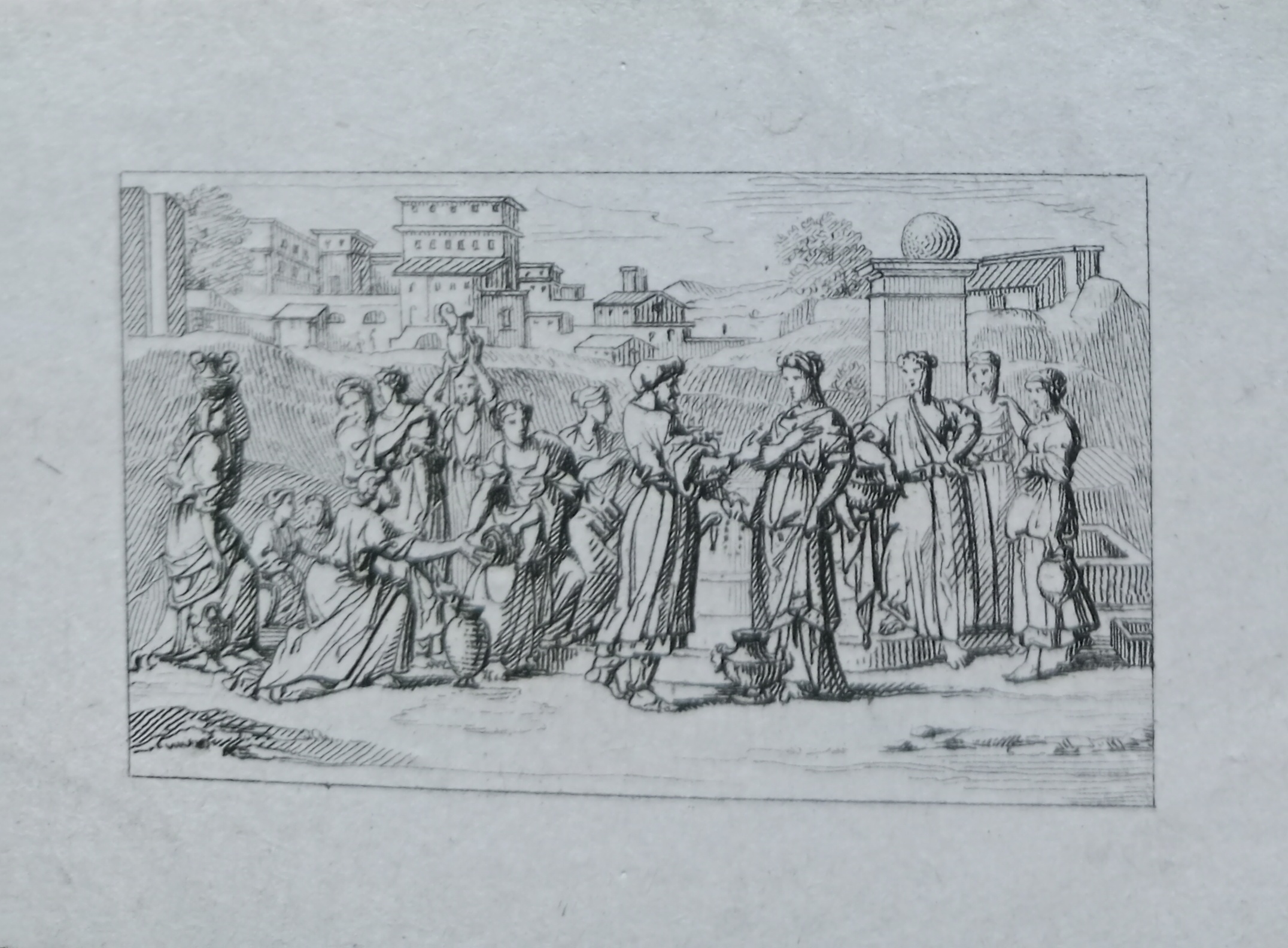
ESCENA DE MITOLOGÍA CLÁSICA. Grabado del Siglo XIX

 ESCENA DE MITOLOGÍA CLÁSICA


ESCENA DE MITOLOGÍA CLÁSICA

Rebeca y Eliezer en el pozo (Génesis 24). El siervo de Abraham, Eliezer, elige a Rebeca como esposa para Isaac después de que ella le ofrece agua a él y a su camello.

Rebecca and Eliezer at the Well (Genesis 24). Abraham’s servant, Eliezer, chooses Rebecca as a bride for Isaac after she offers water to him and his camel.

ICONOGRAFÍA / ICONOGRAPHY
Narración bíblica del Antiguo Testamento. Eliezer coloca un regalo en la muñeca de Rebeca mientras ella hace un gesto modesto hacia su pecho. A izquierda y derecha, varias mujeres cargan, equilibran y llenan cántaros de agua cerca de un imponente pozo clásico coronado por una esfera de piedra. La arquitectura clásica y las torres definen el paisaje urbano a lo lejos.

Old Testament biblical narrative. Eliezer places a gift on Rebecca's wrist while she gestures modestly toward her chest. To the left and right, women carry, balance, and fill water jars near a grand classical wellhead capped with a stone sphere. Classical architecture and towers define the distant cityscape background.

TITULO / TITLE :
Escena de Mitología Clásica

GRABADOR / ENGRAVED :
Desconocido / Unknown

MEDIDAS / MEASURES :
4,5 x 6,5cm

TÉCNICA / TECHNIQUE :
Grabado a buril / Burin engraving

FECHA DE ESTAMPACIÓN / STAMPING DATA:

SERIES / SERIES :
Grabado del Siglo XIX / 19th century engraving :

Miniatura / Miniature :

CATÁLOGO / CATALOGUE: 
Carpeta del Siglo XIX, C 2. sobre 1 Subcarpeta 6