

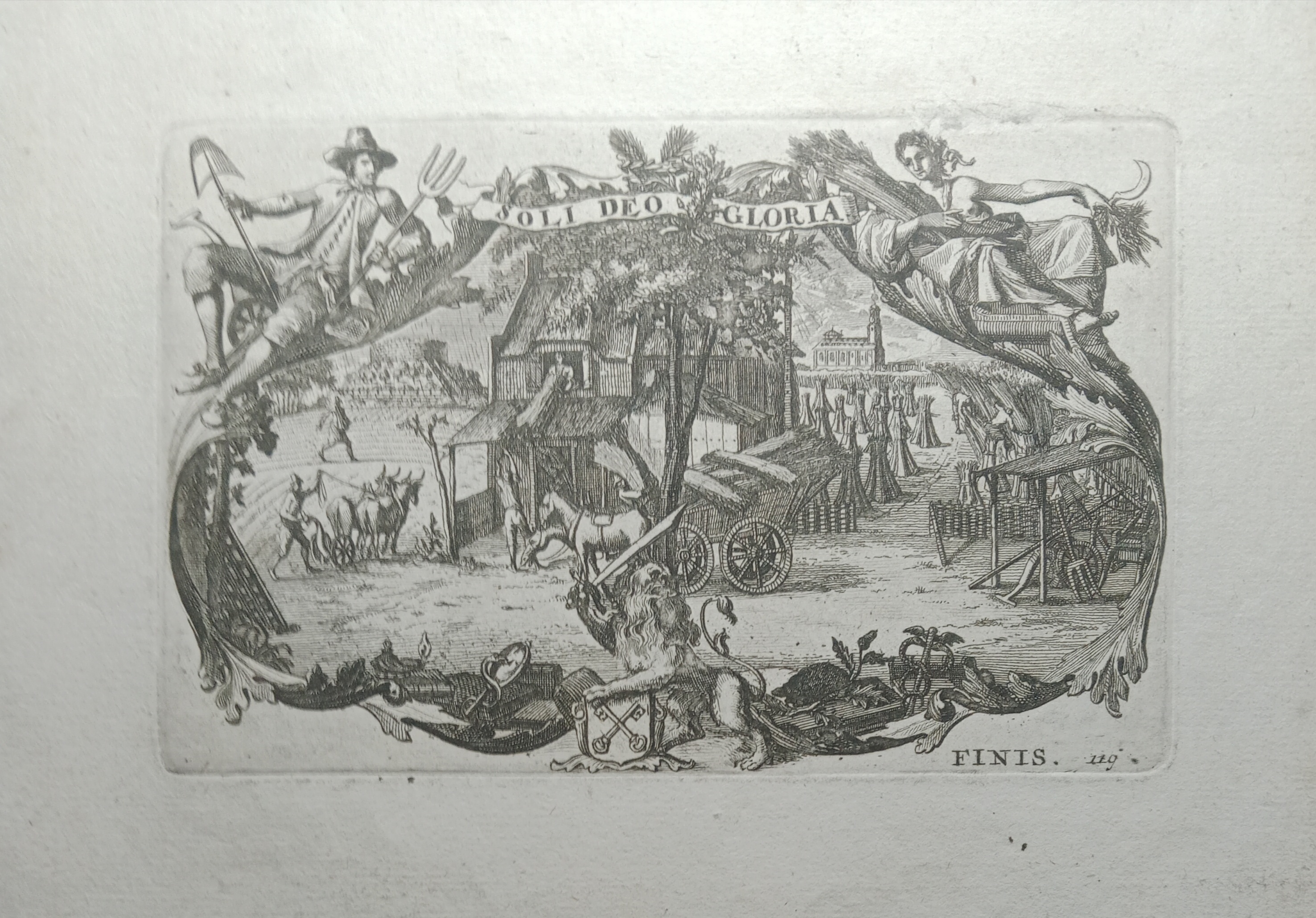
Esta calcografía es muy probablemente un remate, cul-de-lampe o grabado final de un libro— cargada de una rica iconografía alegórica típica del período comprendido entre los siglos XVI y XVIII.
La presencia de la palabra "FINIS." en la esquina inferior derecha, junto con la numeración de página 119, confirma que se trata de la ilustración que cerraba un capítulo o el final de una obra impresa.
La inscripción en la filacteria superior, "SOLI DEO GLORIA" (Solo a Dios la gloria), era una de las cinco solas de la Reforma, pero también un lema ampliamente utilizado por impresores, autores y artistas de diversas confesiones de la época barroca para dar gracias al concluir un trabajo arduo.
El diseño presenta una estructura simétrica enmarcada por una densa rocalla y motivos vegetales que encierran una detallada escena rural y de oficios varios.
_________________________
This intaglio print is most likely a colophon, cul-de-lampe or final engraving from a book—rich in the allegorical iconography typical of the period spanning the 16th to the 18th centuries.
The presence of the word ‘FINIS.’ in the bottom right-hand corner, together with the page number 119, confirms that this is the illustration that concluded a chapter or marked the end of a printed work.
The inscription in the upper scroll, “SOLI DEO GLORIA” (Glory to God alone), was one of the five solas of the Reformation, but also a motto widely used by printers, authors and artists of various denominations during the Baroque period to give thanks upon completing a labourious task.
The design features a symmetrical structure framed by dense rocaille and plant motifs that enclose a detailed rural scene depicting various trades.
