JACQUES ANTONIE MANUEL. 19th century engraving

JACQUES ANTONIE MANUEL
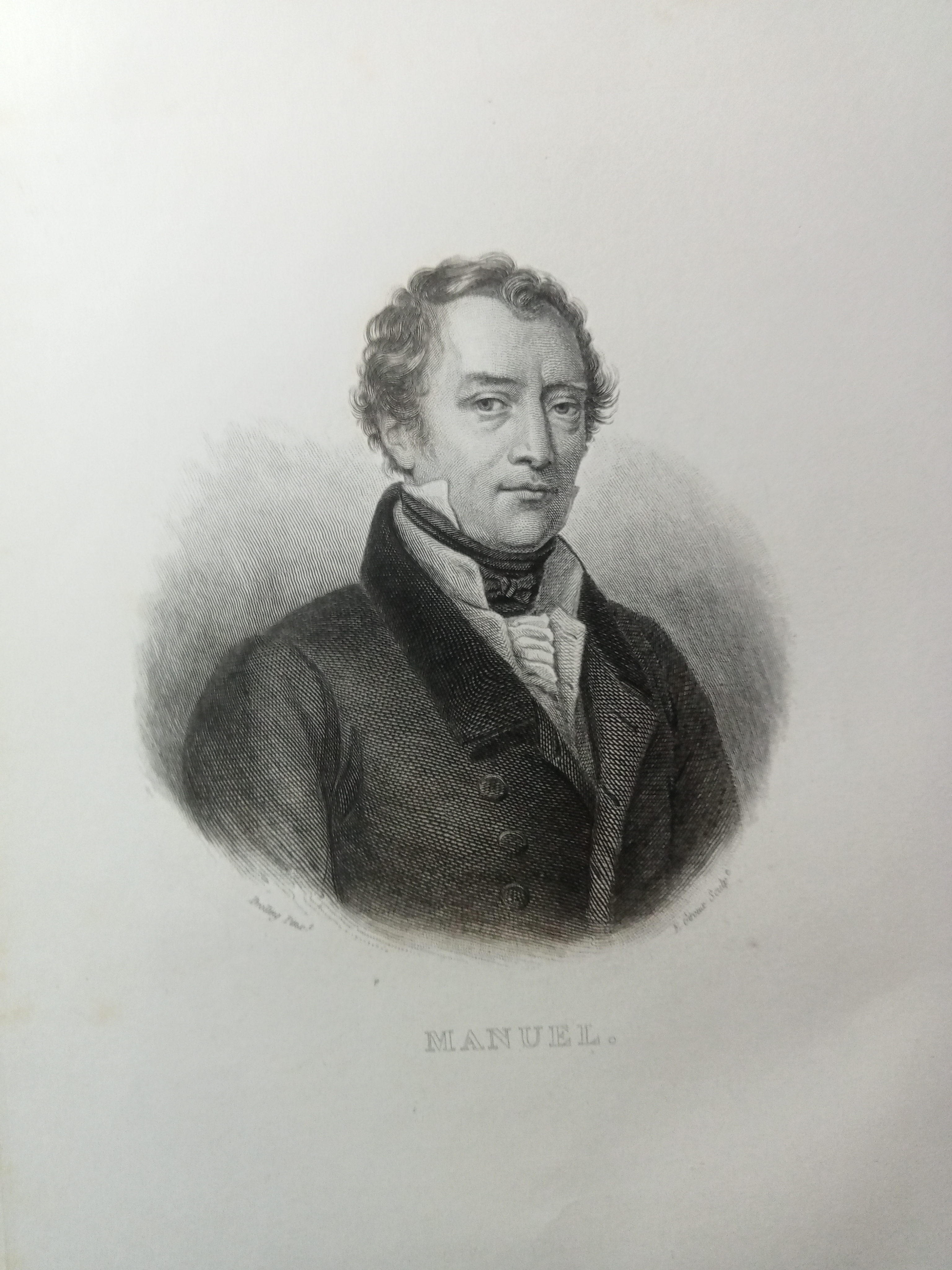

JACQUES ANTOINE  MANUEL  (  1775 - 1827 )

Jacques-Antoine Manuel (1775-1827), destacado abogado, político y orador francés que fue una figura clave de la oposición liberal en la Cámara de Diputados durante la Restauración Borbónica.

Jacques-Antoine Manuel (1775–1827), the prominent French lawyer, politician, and orator who served as a leading figure of the liberal opposition in the Chamber of Deputies during the Bourbon Restoration.

ICONOGRAFÍA / ICONOGRAPHY :
El retratado aparece en un retrato de medio cuerpo, ligeramente girado a la derecha y mirando al espectador. Viste la indumentaria característica del final de la Restauración (hacia la década de 1820): un abrigo oscuro de cuello alto con solapas anchas, un chaleco cruzado y una corbata blanca alta. Sus rasgos expresivos y su cabello rizado coinciden con los retratos contemporáneos típicos de Manuel.

The subject is depicted in a half-length portrait turned slightly to the right, facing the viewer. He wears the characteristic attire of the late Restoration period (c. 1820s): a high-collared dark coat with wide lapels, a double-breasted waistcoat, and a high white cravat. His expressive features and curly hair match standard contemporary portraiture of Manuel.
TITULO / TITLE :
Jacques Antoine  Manuel

EDITOR / PUBLISHER:

GRABADOR / ENGRAVER :
 Emille Giroux  ( 1800 - 1846 )

BIOGRÁFICOS / BIOGRAPHICAL DATA :

OBRAS DEL MISMO GRABADOR EN LA COLECCIÓN PEÑA - GINÉS
WORKS OF THE SAME ENGRAVER IN THE PEÑA - GINES COLLECTION

MEDIDAS / MEASURES :
11 x 9 cm

ESCUELA / SCHOOL:

FECHA DE ESTAMPACIÓN / STAMPING DATA :
1830 a 1860 S / XIX

TÉCNICA / TECHNIQUE :

OBRAS LITOGRÁFICAS EN LA COLECCIÓN:
LITHOGRAPHIC WORKS IN THE COLLECTION :

MATERIAL / MATERIAL :

SERIES / SERIES:
Grabado del Siglo XIX / 19th century engraving

CATÁLOGO / CATALOGUE :
Carpeta del Siglo XIX, C 3 - subcarpeta 5, litografía
19th century folder, C 3 - subfolder 5, lithography

SCÈNE BIBLIQUE. 18th century engraving

 SCÈNE  BIBLIQUE
Grabado del siglo XVIII


Se trata de un grabado que representa la escena bíblica de Job en el muladar (o montón de cenizas), siendo reprendido por su esposa, un tema popular en el grabado europeo de los siglos XVI , XVII y XVIII que explora los límites de la fe, la paciencia y el sufrimiento humano.

This is a engraving depicting the biblical scene of Job on the Dunghill (or Ash Heap) being berated by his wife, a popular theme in 16th and 17th-century European printmaking that explores the limits of faith, patience, and human suffering

TITULO / TITLE :
Scène Biblique

GRABADOR / ENGRAVER :
Pierre Leroy  ( 16 ? - 17 ? )

DATOS BIOGRÁFICOS / BIOGRAPHICAL DATA :

MEDIDAS / MEASURES :
12 x 19cm

TÉCNICA / TECHNIQUE :
Grabado a buril / Burin engraving

MATERIAL / MATERIAL :
Papier Vergé du siècle 18e siècle

ESCUELA / SCHOOL :
Escuela francesa / French School

FECHA DE ESTAMPACIÓN / STAMPING DATE :
1780 , S / XVIII

SERIE / SERIES 
Grabado del siglo XVIII / 18th century engraving

CATALOGO / CATALOGUE :
Carpeta del siglo XVIII, C 2 a - Subcarpeta 2 ( 1751 a 1800 )
18th century folder, C 2 a - Subfolder 2  ( 1751 a 1800 )

SCENA DI BATTAGLIA. 16th century engraving

 SCENA DI BATTAGLIA, Grabado del siglo XVI

  
 SCENA DI BATTAGLIA

ICONOGRAFÍA / ICONOGRAPHY :
Primer plano derecho (El mando):
Un comandante militar de alto rango monta un caballo finamente engalanado. Viste un distintivo sombrero con plumas, una chaqueta de cuero y botas típicas de la caballería de mediados del siglo XVII, y sostiene un bastón de mando. Junto a él, un oficial de infantería o guía señala hacia un enfrentamiento o maniobra de posicionamiento a lo lejos, en el extremo derecho. Un tamborilero militar y un denso grupo de piqueros y mosqueteros portando grandes estandartes los flanquean.

Fondo y primer plano izquierdo (La logística):
Esta sección representa la compleja logística de un ejército de principios de la Edad Moderna en movimiento. Destaca un tren de equipajes, con pesados ​​carros de madera tirados por bueyes y caballos, acompañados por soldados y seguidores del campamento.

El horizonte (El objetivo/Escenario):
El fondo muestra un detallado paisaje urbano caracterizado por una gran cúpula clásica y prominentes torres o chapiteles. El estilo arquitectónico sugiere un entorno italiano o del sur de Europa, o quizás una representación estilizada de una importante ciudad sitiada en Flandes o Alemania (como las vistas habituales que se encuentran en las crónicas históricas).
________________

  • The Right Foreground (The Command):

  • A high-ranking military commander sits astride a finely caparisoned horse. He wears a distinctive plumed hat, a leather buff coat, and boots typical of mid-17th-century cavalry attire, holding a commander's baton (commandostaf). Next to him, an infantry officer or guide points toward a distant engagement or positioning maneuver on the far right. A military drummer and a dense block of pikemen and musketeers carrying large standards flank them.


  • The Left Background & Foreground (The Logistics):

  • This section depicts the heavy logistics of an early modern army on the move. A baggage train (tros) features prominently, including heavy wooden carts pulled by teams of oxen and horses, accompanied by camp followers and soldiers.


  • The Skyline (The Target/Setting):

  • The background features a detailed cityscape characterized by a large classical dome (cupola) and prominent towers or spires. The architectural style suggests an Italian or Southern European setting, or perhaps a stylized representation of a major besieged city in Flanders or Germany (such as standard views found in historical chronicles).


TITULO / TITLE :
Scena di battaglia

GRABADOR / ENGRAVING :

DATOS BIOGRAFICOS / BIOGRAPHICAL DATA :

MEDIDAS / MEASURES :
9 x 27cm

TECNICA / TECHNIQUE :

MATERIAL / MATERIAL:

ESCUELA / SCHOOL :

FECHA DE ESTAMPACIÓN / STAMPING DATE:

PERIODO / PERIOD :

SERIES / SERIES :
Grabado del siglo XVI / 16th century engraving

REFERENCIAS / REFERENCES :

CATÁLOGO / CATALOGUE :
Carpeta del siglo XVI, C 1 - subcarpeta 2
 16th century folder, C 1 - subfolder 2

LA NOTICIA LLEGA AL OLIMPO. 16th century engraving

The news brought to Olympus
 

LA NOTICIA LLEGA AL OLIMPO

ICONOGRAFÍA / ICONOGRAPHY :
El Grupo Central:
Un conjunto de figuras —entre ellas ancianos barbudos y con túnicas, y jóvenes— se encuentran enclavadas en una densa nube, tras un sencillo parapeto o estructura rectangular.
La Figura de la Trompeta:
A la derecha, una figura femenina de estilo clasicista (que suele representar a la Fama, una Musa o una Sibila profética) toca una trompeta recta (tubae), dirigiendo su atención hacia el grupo central.
La Visión Celestial:
En la parte superior izquierda, dentro de un círculo perfecto (un tondo), se representan una figura masculina sentada y una figura femenina dinámica (frecuentemente asociadas con temas de la creación, como Júpiter y Juno, o una representación clásica de Adán y Eva).

_______________________________
The Central Group:
A gathering of figures—including draped, bearded elders and younger individuals—are nestled within a dense bank of clouds, positioned behind a plain rectangular parapet or structure.
The Trumpet-Bearing Figure:
On the right, a classicizing female figure (often embodying Fame, a Muse, or a prophetic Sibyl) blows a straight trumpet (tubae), directing her attention toward the central group.
The Celestial Vision:
In the upper left, enclosed within a perfect circle (a tondo), a seated male figure and a dynamic female figure are depicted (frequently associated with themes of creation, such as Jupiter and Juno, or a classical rendering of Adam and Eve).

TITULO / TITLE :
La notícia llega al Olimpo / The new brought to Olympus

AUTOR / AUTHOR :
Bacio Bandinelli ( 1493 - 1560 )

DATOS BIOGRÁFICOS / BIOGRAPHICAL DATA :

GRABADO / ENGRAVING:
Agostino Veneciano ( 1496ca - 1540ca )

MONOGRAMA / MONOGRAM A.V.

DATOS BIOGRÁFICOS / BIOGRAPHICAL DATA:

MEDIDAS / MEASURES :
12 x 27 cm

TECNICA / TECHNIQUE :

MATERIAL / MATERIAL :

PERIODO / PERIOD: Renacimiento / Renaissance

ESCUELA / SCHOOL :

FECHA DE ESTAMPACIÓN / STAMPING DATE :
1517 , S / XVI

SERIES / SERIES : Grabado del siglo XVI

REFERENCIAS / REFERENCES :
* The British Museum nª 1862,1213.49
* The Metropolitan Museum of Art , Collection Elisha Whittelsey nº 49.97.83
* Museum of fine arts , Budapest, inv nº 5313
* Museum of fine arts Boston nº P1247
*Museum Boijmans nº BdH 3902 di. (PK)
* Rijsmuseum nº RP-P-H-H-182

CATALOGO / CATALOGUE :
Carpeta del siglo XVI / 16th century folder